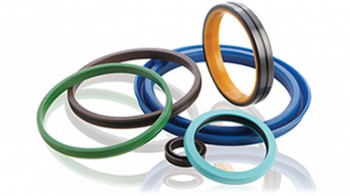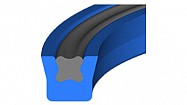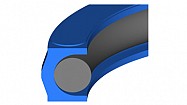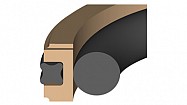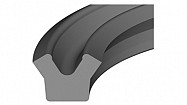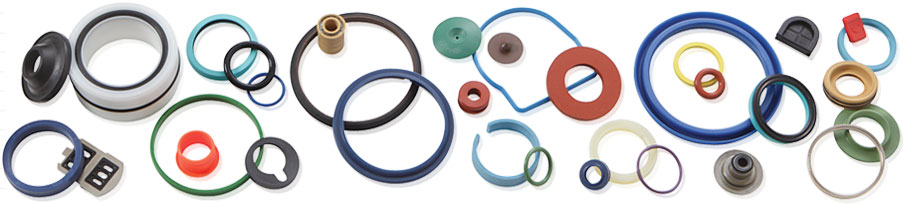

The demands placed on a piston seal depends greatly upon the operating conditions for which they have been chosen. Bore surface finish, hydraulic fluid type, contamination, application cycle rate and speed, pressure, and temperature are just a few of the factors that can help determine what kind of seal is right for a given application. Unlike a rod seal, where leaking of hydraulic fluid is not acceptable, a small amount of leakage in piston area is generally seen as desirable. This small amount of fluid acts as a lubricant for the piston seal during operation. Piston seals, both single- and double-acting, can be designed for use with integrated or separate back-up or guide rings. It is critical to choose the type of seal designed to provide the correct amount of lubrication film that can pass through the contact area between the seal and the cylinder tube surface. Failure to do so could result in stick / slip operation if the friction is too high, or increased wear rate of the seal, if the bore walls are wiped clean of lubrication. |
![]() |
||
Click on thumbnails for technical information
|
|||
| T Seal
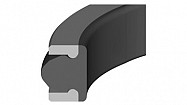
T-seals are designed to retrofit O-rings, either in static or for their intended use in reciprocating applications. T-seals construction consists of a basic T shaped elastomer, usually flanked by two specially fitted back-up rings. Since T-seals are designed to retrofit O-ring grooves, they are available in different widths depending on the type of O-ring, or O-ring/back-up combination they are replacing. One of the main advantages of the T-seal is that the T base construction is highly resistant to spiraling during installation and operation.
|
|
||
| Capped T-Seal
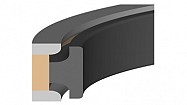
Capped T-seals are similar in function to that of a normal T-seal, except the elastomer energizes a PTFE cap that seals the dynamic surface. Since the PTFE cap is made a low friction material, capped T-seals are well suited as heavy duty piston seals in high duty cycle linear actuators. Low friction also means low wear, which provides excellent long term life capability.
|
![]() |
||
| Urethane Seal
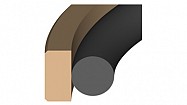
The urethane seal is an excellent middle ground sealing choice between the T/Capped T seal and the O-ring loaded seal. The urethane seal features two sharp sealing lips, but is a specially designed to include a basin that provides for a cache of lubricating fluid. This allows for a higher amount of sealability than a T seal, but lubricates the surface enough to reduce the risk of stick slip. The urethane seal, just like both the T-seal and O-ring loaded seal is designed to fit within a standard O-ring groove. A feature not found in other bi-directional seals is that the urethane seal includes grooves that are cut into the side of the seal face. These grooves are designed to reduce blow-by failures if there is a sudden change in system hydraulic pressure. Made from hard extrusion and wear resistant polyurethane, the urethane seal also features a square cut O-ring for use as an energizer of the polyurethane lip. The square shape of energizer is slightly more stable than a round O-ring would provide and this further reduces the risk of seal damage during installation and usage.
|
![]() |
||
| PTFE Seal
A PTFE piston seal is ideal for most high duty cycle linear actuators, since it provides low friction and long service life. PTFE piston seals are relatively low cost options, and due to the low friction of PTFE can almost eliminate stick-slip behavior in piston movement. Please note, for proper use they must be used in conjunction with an O-ring energizer. Depending on the demands of your application, PTFE piston rings come in over 1500 different combinations of materials, cross-sections, cuts, and other special features. For material choices alone, there are over 10+ different options to choose from. Among the most popular are 40% bronze filled PTFE, 15% glass filled PTFE, and 5% molybdenum disulfide (Moly) filled PTFE.
|
![]()
|
||
Loaded U-cup
The loaded U-cup is a single direction piston seal, meaning it can only seal if the pressure is coming from one direction. Since the sealing method is single directional, two loaded U-cups must be installed for dual direction hydraulic piston applications. The lip designed is a straight lip design, so the loaded U-cup has good sealability but also proves to be excellent at contamination removal away from the sealing lip. Overall, the shape of the loaded U-cup is a large rectangle that greatly adds to the stability of the seal. Also like most polyurethane seals, the loaded U-cup features a Quattro ring energizer, which is designed to activate the seal at lower pressures.
|
![]() |
||
| O-Ring Loaded Seal
An O-ring loaded seal has the highest level of sealability for all the dual-action piston seals. Similar in function to a capped T-seal, the apex seal uses an elastomer energizer to activate the thermoplastic sealing element. The sealing element can be made of either lubrithane or fluorotrel, both of which offer superior wear and extrusion resistance. A back beveled sealing lip gives this seal excellent sealability at both high and low pressures. O-ring loaded seals, just like T and Capped T seals are designed to retrofit standard O-ring grooves. Since too much sealing force can cause stick slip conditions, this seal is recommend for applications were the maximum amount of sealability is required. Also since the cross section is relatively square, it is also recommend for use in applications with limited axial movement
|
![]()
|
||
| Asymmetrical Unloaded U Cup
Unlike a standard U-cup where both sides of the seal have the same dimensions, the asymmetrical unloaded U-cup is designed to have both a static and a dynamic side. The static side features a tall lip in order to increase the stability of the seal. On the dynamic side, the prominent feature is a reduced height seal lip, with good film breaking capabilities. The asymmetrical U-cup is a single direction piston seal, meaning it can only seal if the pressure is coming from one direction. Since the sealing method is single directional, two loaded U-cups must be installed for dual direction hydraulic piston applications.
|
![]()
|
||
| Grooved Seal
Grooved seals are bi-directional seals that are specially designed to deal with a wide range of sealing pressures. This seal type features two different pressure sensitive energizers, and it is capable of handling a wide range of pressures, while still maintaining a good level of sealability. The Quattro ring at the top is the low pressure energizer of the PTFE seal. At higher pressures this Quattro ring is not as effective, and instead the O-ring below is the energizer for the PTFE cap. As an added bonus, the center groove on the PTFE piston ring cap acts as a reservoir for lubrication during operation.
|
![]()
|
||
Symmtrical U-cup
U-Cups are popular due to the small gland space required. They are usually specified in low speed, low pressure environments for both pneumatic and hydraulic cylinders. The seal is obtained by means of the flared, flexible lips coming in contact with the rod or cylinder wall. Clearance is provided at the heel for minimum friction. Seal effectiveness is increased as internal pressure increases against the inner surface of the lips. |
![]() |
||