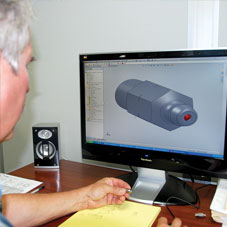
All Seals has spent the last 40 years helping our customer optimize the seal engineering. Our Consultation includes:
The following tolerance information is for reference purposes only and is intended to provide an indication of the types of tolerances which can be achieved with a molded part. This chart does not represent a guarantee of the tolerances which can be achieved in all cases. In many instances, specific part geometry will affect the precision of the tolerances which can be achieved. Please contact our Customer Service Group if you need a tolerance assessment conducted for a specific product.
| Dimension |
Fixed Dimension Tolerance |
Closure Dimension Tolerance |
| (in) |
(mm) |
(in) |
(mm) |
(in) |
(mm) |
| .001 - .250 |
.0254 - 6.350 |
±.004 |
±.102 |
±.005 |
±.127 |
| .251 - .500 |
6.375 - 12.700 |
±.004 |
±.102 |
±.005 |
±.127 |
| .501 - .625 |
12.725 - 15.875 |
±.005 |
±.127 |
±.006 |
±.152 |
| .626 - .750 |
15.900 - 19.050 |
±.006 |
±.152 |
±.008 |
±.203 |
| .751 - 1.000 |
19.075 - 25.400 |
±.006 |
±.152 |
±.008 |
±.203 |
| 1.001 - 1.500 |
25.425 - 38.100 |
±.008 |
±.203 |
±.010 |
±.254 |
| 1.501 - 2.000 |
38.125 - 50.800 |
±.010 |
±.254 |
±.013 |
±.330 |
| 2.001 - 2.500 |
50.825 - 63.500 |
±.010 |
±.254 |
±.013 |
±.330 |
| 2.501 - 3.000 |
63.525 - 76.200 |
±.014 |
±.355 |
±.015 |
±.381 |
| 3.001 - 3.500 |
76.225 - 88.900 |
±.017 |
±.432 |
±.018 |
±.457 |
| 3.501 - 4.000 |
88.925 - 101.600 |
±.020 |
±.508 |
±.020 |
±.508 |
| 4.001 - 5.000 |
101.625 - 127.000 |
±.025 |
±.635 |
±.025 |
±.635 |
| 5.001 - 7.000 |
127.025 - 177.800 |
±.035 |
±.890 |
±.035 |
±.890 |
| 7.001 - 8.000 |
177.825 - 203.200 |
±.040 |
±1.016 |
±.040 |
±1.016 |
| 8.001 - 9.000 |
203.225 - 228.600 |
±.045 |
±1.143 |
±.045 |
±1.143 |
| 9.001 - 10.000 |
228.625 - 254.000 |
±.050 |
±1.270 |
±.050 |
±1.270 |
| 10.001 - 11.000 |
254.025 - 279.400 |
±.055 |
±1.397 |
±.055 |
±1.397 |
| 11.001 - 13.000 |
279.425 - 330.200 |
±.065 |
±1.651 |
±.065 |
±1.651 |
| 13.001 - 14.000 |
330.225 - 355.600 |
±.075 |
±1.905 |
±.075 |
±1.905 |
| 14.001 - 15.000 |
355.625 - 381.000 |
±.090 |
±2.286 |
±.090 |
±2.286 |
We will ask questions to help us better understand your application like:
- Seal a fluid? (Impermeable to particular fluid?)
- Transmit a fluid?
- Transmit energy?
- Absorb energy?
- Provide structural support?
- Temperature/Pressure Range of the part
- Water, chemicals or solvents that could cause shrinkage of the part?
- Oxygen or ozone?
- Sunlight?
- Wet/dry situation?
- Constant pressure or pressure cycle?
- Dynamic stress, causing potential deformation?
- Need to stretch without breaking (high ultimate elongation)?
- Resistance to deformation (high modulus)?
- Resistance to set under extensive load (high compression set)?
- Resistance to dimensional changes or embrittlement in the presence of heat or fluids?
Elastomeric materials are available in a wide variety of hardnesses, from 20 Shore A to 90 Shore A for thermoset rubbers, to even harder materials (Shore D scale) for thermoplastic elastomers. The most common hardness range for materials is from 50 Shore A to 80 Shore A, with most sealing products being made from materials with a hardness of 70 Shore A. The actual hardness which will be selected depends upon your exact application.
There are some restrictions on the use of very hard and very soft materials in terms of manufacturing limitations. Parts with complex geometry or deep undercuts can be difficult to manufacture from very soft (< 30 Shore A) or very hard (> 80 Shore A) materials.
The following is a list of common problems sometimes encountered when designing rubber parts, and some suggestions for avoiding them.
- Attempting to compress rubber (or overfilling the groove)
- Designing a rubber part which cannot be manufactured
- Creating stress points by designing sharp corners instead of radius edges
- Not providing installation tools and/or employee training
- Failing to consider all possible chemicals/processes which may contact the rubber component
- Not providing sufficient lubrication for a seal or other dynamic rubber part
- Not properly tolerancing and specifying the mating parts/ glands
- Not allowing enough room for a seal or rubber part
- Using too small a seal or rubber part ( not enough compression)
- Using a seal as a bearing
- Not considering rubber thermal effects
- Not accounting for seal friction and power loss
- Placing common metal tolerances or specifications on rubber parts
|