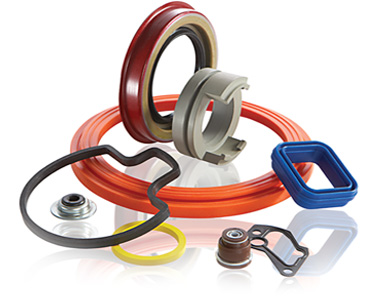
All Seals is a recognized leading converter of high qualitysilicone rubber gaskets, seals, and custom silicone products. Our company’s reputation for excellence has been built on our ability to provide our valued customers with the most effective designing, engineering and converting solutions to meet their most demanding applications. Our main objective is to continuously exceed our customer’s expectations by providing them with high performance gaskets and sealing products, competitive pricing, on-time delivery and exceptional customer service.
All Seals has experience in the providing of precision cut and molded silicone rubber gaskets and seals for a wide range of industries and applications. Silicone rubber is a high-performance elastomer with exceptional resistance to temperature extremes. Silicone molded and die cut gaskets remain functional within a temperature range of -67°F to +400°F, intermittent to +450°F. The low temperature flexibility of silicone is unmatched by any other elastomer. Silicone gaskets are often chosen due to their excellent resistance to chemicals, water, fire, fungal growth, ozone, heat and aging. Silicone has outstanding tensile strength, elongation, tear strength, and compression set. The versatility and long service life of silicone make it ideal for a wide variety of applications.
Die Cut Viton™ Gaskets
All Seals converts Viton™ rubber gaskets and water jet cut Viton™ rubber gaskets in a wide variety of grades, thicknesses and hardness. The standard thickness of Viton™ rubber ranges from 1/64" to 1/4" thick. Viton™ rubbers hardness (durometer) typically spans from 55 to 90 durometer, Shore A. Die cut Viton™ gaskets are generally black or brown in color. Viton™ gaskets are available with or without pressure sensitive adhesive (PSA) backing.
All Seals Available Viton™ Grades
Viton™ "A" (Commercial Grade, 66% Fluorine)
Viton™ "A" (Premium Grade, 66% Fluorine)
Viton™ "A" (FDA Grade, 66% Fluorine)
Viton™ "B" (Premium Grade, 68% Fluorine)
Viton™ "F" (Premium Grade, 70% Fluorine)
Viton™ Extreme
Viton™ Base
Viton™ Sponge
Molded Viton™, Fluorocarbon (FKM) Gaskets
All Seals specializes in the converting ofcustom molded Viton™ gaskets and seals. Our custom Viton™ (FKM) molding capabilities include Compression Molding, Transfer Molding, and Rubber Injection Molding. Fluorocarbon, Viton™ (FKM) compounds are available from 55 to 90 durometer, Shore A. Viton™ molded gaskets are generally black, brown, or white in color, however custom color compounding is available upon request. Viton™ molding tolerances are complaint with rubber molding industry standard RMA A2 Precision tolerances.
Viton™ is a trademark of The Chemours Company FC, LLC.

 All Seals is a recognized leading converter of high qualitysilicone rubber gaskets, seals, and custom silicone products. Our company’s reputation for excellence has been built on our ability to provide our valued customers with the most effective designing, engineering and converting solutions to meet their most demanding applications. Our main objective is to continuously exceed our customer’s expectations by providing them with high performance gaskets and sealing products, competitive pricing, on-time delivery and exceptional customer service.