
Back-Up Rings

Extrusion failure is one of the most common types of O-ring failure.  When the internal pressure of an application becomes too great, the O-ring will actually extrude into the clearance gap.  This extrudate will quickly be nibbled away causing a loss of material, and once sufficient material is lost, seal failure will quickly follow. 

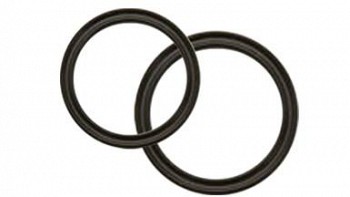
There are three options to prevent this, the first of which is to reduce the clearances to lower the extrusion gap. This is obviously an expensive option, so a cheaper solution is to raise the durometer of the O-ring.  Although, a higher durometer O-ring offers superior extrusion resistance, is often not feasible solution due to material availablilty, and to the fact that harder durometer materials have limited low pressure sealability.  The last and best option is the addition of a backup ring.  A backup ring is a ring of hard, extrusion resistant material such as high durometer nitrile, nylon, Hytrel, or PTFE.   A back-up ring is designed to fit between the O-ring and the extrusion gap and prevent the extrusion of the O-ring. 

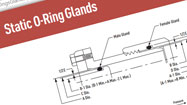
While back-up rings are used in conjunction with O-rings in both static and dynamic sealing applications, the gland they fit in must be specially designed to fit both the O-ring and the back-up.  For more information on gland design please visit All Seals's static or dynamic gland design guides.

Materials:  
 

Standard Back Up Ring

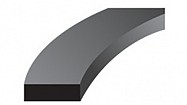
Used primarily as an anti-extrusion device, standard back-up rings are used in both static and dynamic sealing. Made of materials that are resistant to pressure induced flow, the back-up ring keeps a seal from extruding into the clearance gap between mating parts.

All Seals's standard Hytrel® back-up rings are equivalent to AN6224, AN6246, MS28774, MS28782, and MS28783 specifications.  The PTFE back-up rings are specifically cut to MS28774 specifications.  Both types of back-up rings share a common rectangular cross-section.


Contoured Back-Up Rings

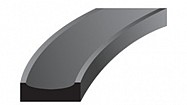
Contoured back-up rings are anti-extrusion devices, used in both static and dynamic sealing environments; they are also useful when mating part clearances are not tightly controlled. In either case they can extend the useful lfe of O-rings. Contoured back-up rings have a slightly concave face on one side, enabling uniform contact with the entire diameter of the O-rings they are used with. Sizes correspond with AS568 O-rings. Whenever possible, the use of two back-up rings is recommended, even in single-acting applications.